
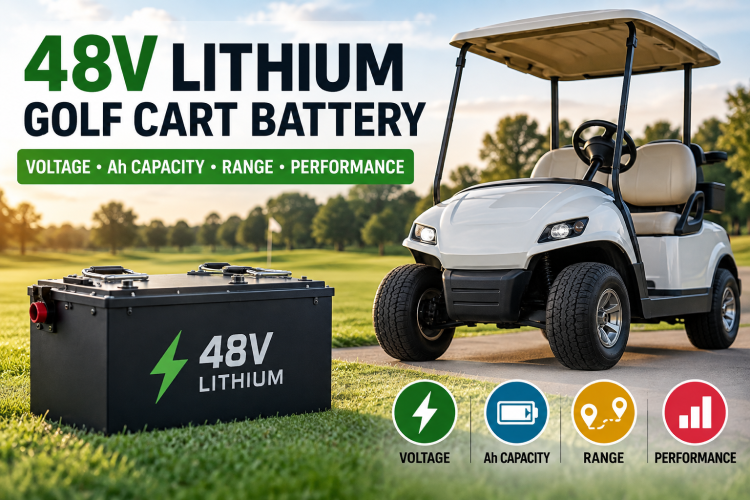
How do you know if a 48V lithium golf cart battery will actually deliver the range and power you expect? A 48V lithium battery offers strong performance, lighter weight, faster charging, and consistent power. However, Ah capacity, motor demand, terrain, driving habits, and battery quality all affect real-world range and performance.
⚡ What Is A 48V Lithium Golf Cart Battery?
A 48V lithium golf cart battery is a rechargeable battery pack designed to power a 48-volt golf cart system. Most modern lithium golf cart batteries use lithium iron phosphate (LiFePO4) chemistry. This chemistry is popular because it provides good energy density, long service life, and stable performance. Compared with traditional lead-acid batteries, lithium packs are also much lighter. 🚗
The 48V rating describes the battery system voltage, while amp-hours describe how much energy the battery can store. Therefore, two 48V batteries can have very different driving ranges. For example, a 48V 50Ah battery stores less energy than a 48V 100Ah battery. Understanding both numbers helps you choose the right golf cart battery.
🔋 Understanding 48V Battery Voltage
Voltage tells you how much electrical potential the battery provides to the golf cart. A 48V system is commonly used in modern golf carts because it can provide efficient power for motors and accessories. The actual voltage of a lithium battery will change during charging and use. Therefore, seeing a voltage above or below 48V at certain times is normal.
A compatible battery must match your golf cart’s electrical system. Installing a battery with the wrong voltage can cause serious performance or electrical problems. Always check your cart’s specifications before buying. A 48V lithium battery should be used with a properly matched 48V system.
| Battery System | Typical Capacity | Approx. Stored Energy |
| 48V 30Ah | 30Ah | 1.44 kWh |
| 48V 50Ah | 50Ah | 2.40 kWh |
| 48V 75Ah | 75Ah | 3.60 kWh |
| 48V 100Ah | 100Ah | 4.80 kWh |
| 48V 150Ah | 150Ah | 7.20 kWh |
Stored energy is calculated as nominal voltage × amp-hours.
📏 What Does Ah Capacity Mean?
Amp-hours (Ah) indicate the battery’s capacity. In simple terms, a higher Ah rating generally means the battery can provide energy for longer. However, Ah alone does not guarantee a specific driving distance. Motor efficiency, cart weight, speed, hills, tire pressure, temperature, and driving style all matter.
For example, a 48V 100Ah battery has roughly twice the stored energy of a 48V 50Ah battery. That does not always mean it will travel exactly twice as far. Real-world conditions can reduce the usable range. 🌳 For most buyers, Ah capacity is one of the most important specifications to compare.
🛣️ How Far Can A 48V Lithium Battery Go?
The range of a 48V lithium golf cart battery depends heavily on its capacity and the cart’s energy consumption. A 48V 100Ah battery contains about 4.8 kWh of nominal energy. If a golf cart uses around 100–150 Wh per mile, the theoretical range could be roughly 32–48 miles.
Real-world range can be lower because no battery system operates under perfect conditions. Hills, heavy loads, high speeds, cold weather, and frequent acceleration can increase energy use. A flat course with moderate driving may produce better results. ⚡ Always treat advertised range as an estimate rather than a guaranteed distance.
| 48V Battery | Nominal Energy | General Range Potential* |
| 30Ah | 1.44 kWh | About 10–15 miles |
| 50Ah | 2.40 kWh | About 16–24 miles |
| 75Ah | 3.60 kWh | About 24–36 miles |
| 100Ah | 4.80 kWh | About 32–48 miles |
| 150Ah | 7.20 kWh | About 48–72 miles |
Illustrative estimates only. Actual range varies by cart, terrain, speed, load, temperature, and battery condition.
🚀 How Lithium Batteries Affect Performance
Lithium batteries can provide more consistent voltage during discharge. This can help a golf cart maintain stronger acceleration as the battery gets lower. Lead-acid batteries tend to experience a more noticeable voltage drop under heavy loads. Lithium technology can therefore provide a more consistent driving experience.
Weight is another major advantage. A lithium battery pack can weigh substantially less than an equivalent lead-acid setup. Lower weight can reduce the load carried by the cart and may improve handling and efficiency. Less battery weight can also make the cart feel more responsive.
🔌 Charging A 48V Lithium Golf Cart Battery
A 48V lithium battery requires a charger designed for its specific lithium battery chemistry and voltage profile. Do not assume that an old lead-acid charger is automatically compatible. Using the wrong charger can cause charging problems or damage the battery system. 🔌
Many lithium golf cart batteries include a battery management system, often called a BMS. The BMS monitors important conditions such as voltage, current, and temperature. It can help protect the battery from unsafe operating conditions. Follow the manufacturer’s charging instructions for the safest results.
🛡️ Why The Battery Management System Matters
The BMS is an important part of a quality lithium golf cart battery. It helps monitor individual cells and manages charging and discharging conditions. Some systems also provide protection against overcharging, excessive discharge, overcurrent, and high temperatures. This protection helps support safe and reliable operation.
However, a BMS does not make every battery installation automatically safe. The battery still needs correct wiring, proper installation, and a compatible charger. The motor controller must also be suitable for the battery system. Battery quality involves more than simply choosing a high Ah number.
🌡️ Factors That Change Battery Range
Your golf cart’s range can change significantly from one trip to another. Temperature is one factor, especially in very cold conditions. Heavy passengers, cargo, steep hills, soft terrain, and frequent acceleration can also increase energy consumption.
Your driving habits matter, too. Driving at maximum speed uses more energy than steady moderate-speed driving. Keeping tires properly inflated can help reduce rolling resistance. To improve range, focus on these areas:
- Maintain correct tire pressure.
- Avoid unnecessary high-speed driving.
- Reduce excess cargo weight.
- Keep battery connections secure.
- Use the correct lithium charger.
- Avoid repeatedly running the battery completely empty.
🧮 How To Choose The Right 48V Battery
Choosing capacity starts with understanding how you use your cart. A homeowner driving short distances may not need the same capacity as someone using a cart throughout a large property. Golf course use, neighborhood driving, hunting properties, resorts, and commercial applications can all have different requirements.
Use this simple process when comparing batteries:
- Confirm your cart requires 48V.
- Estimate your normal daily driving distance.
- Check the battery’s Ah rating.
- Compare the battery’s continuous and peak current capabilities.
- Check the BMS specifications.
- Confirm charger compatibility.
- Review battery dimensions and weight.
- Check the manufacturer’s warranty and support.
A higher-capacity battery can provide more stored energy, but it may also cost more and weigh more. Choose capacity based on your actual driving needs rather than buying the biggest battery available.
💰 Lithium Vs. Lead-Acid Golf Cart Batteries
Lithium batteries usually have a higher upfront price than traditional lead-acid batteries. However, their lower weight, faster charging potential, usable capacity, and longer service life can make them attractive for frequent golf cart users. Lead-acid batteries remain common because their initial purchase cost is often lower.
| Feature | 48V Lithium | 48V Lead-Acid |
| Weight | Lower | Higher |
| Usable Capacity | Generally higher | Generally lower |
| Charging | Typically faster | Typically slower |
| Maintenance | Low | Higher |
| Voltage Consistency | Strong | More voltage drop |
| Upfront Cost | Higher | Lower |
| Cycle Life | Generally longer | Generally shorter |
Actual results depend on the battery model, charging practices, operating conditions, and manufacturer.
🔧 Installation And Maintenance Tips
A lithium golf cart battery can require less routine maintenance than lead-acid batteries. You typically do not need to add water or perform the same level of battery maintenance. Still, the electrical connections should remain clean, secure, and properly installed.
Before installation, check the battery dimensions, terminals, cables, charger, and controller requirements. Make sure the battery is firmly secured inside the cart. Never modify electrical connections unless you understand the system or have qualified help. Proper installation protects both performance and safety.
❓ People Also Ask About 48V Lithium Batteries
How Many Ah Do I Need For A 48V Golf Cart?
For many recreational applications, 50Ah to 100Ah can be a useful range to consider. Your ideal capacity depends on driving distance, passenger weight, terrain, and motor demands. Frequent or long-distance users may benefit from higher capacity.
How Far Will A 48V 100Ah Battery Go?
A 48V 100Ah battery stores about 4.8 kWh of nominal energy. Depending on energy consumption, terrain, speed, and load, its practical range can vary widely. A rough estimate may fall around 30–50 miles for some golf carts.
Is 48V Lithium Better Than Lead-Acid?
Lithium and lead-acid batteries have different advantages. Lithium usually offers lower weight, consistent power, low maintenance, and longer service life. Lead-acid batteries can have a lower upfront purchase price.
What Charger Does A 48V Lithium Battery Need?
Use a charger specifically designed for your 48V lithium battery chemistry. The charger’s voltage and charging profile must match the battery manufacturer’s requirements. Check the battery manual before connecting a charger.
Does A Bigger Ah Battery Give More Range?
Generally, yes, because a higher Ah rating means more stored energy at the same voltage. However, range does not increase in a perfect one-to-one ratio. Vehicle weight, terrain, speed, temperature, and driving behavior also affect range.
🏁 Conclusion
A 48V lithium golf cart battery can offer strong range, consistent power, low maintenance, and a significant weight advantage. The key specifications to understand are voltage, Ah capacity, usable energy, current output, BMS protection, and charger compatibility. A 48V 100Ah battery, for example, stores about 4.8 kWh of nominal energy, but actual driving range depends on many factors.
Before buying, match the battery to your golf cart’s electrical system and driving needs. Consider your typical distance, terrain, passenger load, charging routine, and desired performance. Most importantly, do not choose a battery based on Ah alone. The right combination of capacity, power output, quality, compatibility, and safety features creates better long-term performance.